N2xxC, rotation speed sensor
Description
Hall-effect sensor in a cylindrical housing with an electronic unit integrated into the sensor housing. Output: pulse signal, current; three-wire connection. Maximum operating temperature: up to +125 °C.
Designed for use in rotor rotational frequency monitoring channels together with the controllers of the "Vibrobit 300" and "Vibrobit 500" systems.
Key features:
- Additional functions: direction-of-rotation detection, an additional pulse output, or a fault diagnostic signal;
- Mounting and electrical parameters are equivalent to those of Braun sensors;
- Insensitive to radial shaft runout;
- Sensor output: rectangular current pulses of constant amplitude, with a pulse repetition frequency corresponding to the tooth profile of the target surface.
Specifications
| Measurement principle | Hall-effect |
| Measured value | rotational frequency |
| Compatibility with transducers | - |
| Frequency range | 0 – 20 kHz |
| Shaft control surface type | Pinion; Groove; Key |
| Control surface material (metal) | ferromagnetic steel |
| Registry number | 87625-22 |
| Limit of speed permissible relative measuring error, % | 0.1 |
| Calibration interval, years | 3 |
| Output signal type | current pulses |
| Maximum operating output current, mA | - |
| Connection diagram (number of lines) | 4-wire |
| Power supply voltage range, V | + (10 – 30) |
| Current consumption (max), мА | 40 |
| Operating temperature range, °С | −40 to +125 |
| Housing index of protection according to GOST 14254 | IP67 |
| Resistance to external influencing factors GOST 30631–99 | M5 |
| Connection | ST1210/S6 |
| Overall dimensions, mm | cylindrical housing with thread |
| Service life, years (min.) | 10 |
| Warranty period, months | 36 |
| MTBF, hours | 150000 |
Applications
Measurement of rotational speed and phase on auxiliary equipment at an ambient temperature not exceeding +125 °C. The sensors can be used both independently, for rotational speed measurement, and as part of a process control system.
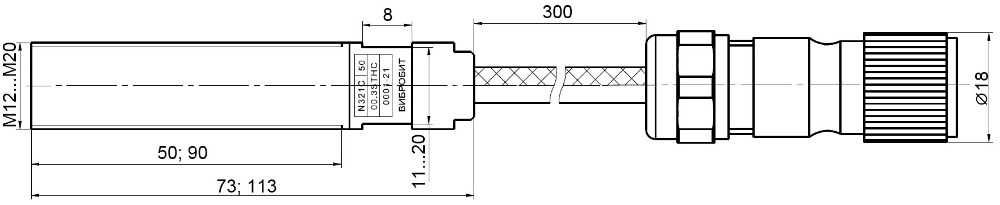
Dimensions and connection diagram